The System Was Never Built for You: How Nigeria’s Education System Crushes the Dreams of Poor Nigerian Children
Ayodeji Aladejana · 11 May 2026
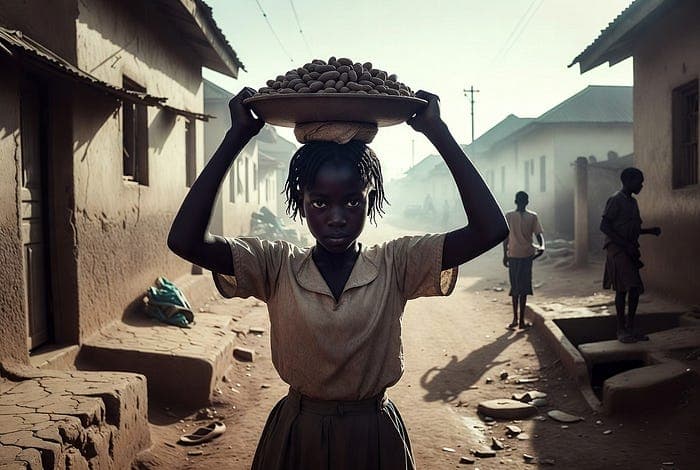
Adaeze is a 12-year-old JSS 2 student of a government-owned secondary school somewhere in Agulu, Anambra State. On an average school day, Adaeze wakes up to the sound of her mother already moving in the dark, preparing akamu for the day’s trade. By 6:30 am, Adaeze has strapped a tray of groundnuts to her head and is walking the morning streets before the sun has fully risen. She hawks for an hour, then changes her clothes, packs her worn exercise books into a bag someone in her church gifted her, and walks about 30 minutes to school.
She is often late to her classroom, which she shares with 62 other children. Their teachers are sometimes owed up to six months’ salary, and most of them are quietly considering greener pastures. The desks are broken, and the textbooks are shared at a 5-to-1 ratio. The window that lets in light has been missing its glass pane since it was damaged by strong winds one rainy afternoon in 2022. Adaeze sits, tries to concentrate, tries to understand the fractions on the board through the haze of fatigue, and waits for the day to end.
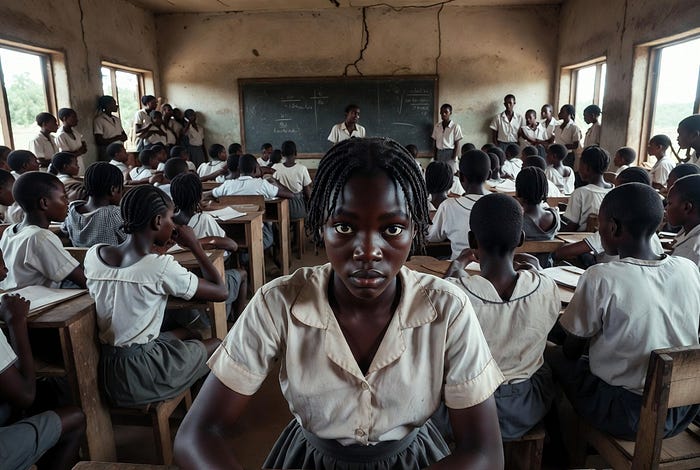
After school, the tray goes back on her head. For three more hours, she hawks cold pure water and soft drinks. She then helps her mother in the shop until 9:00 pm or 10:00 pm, depending on that day’s sales. At home, she still has to wash plates and fetch water. Then, and only then, does she open her books. By the time her pen touches paper, her body is running on the residual energy of obligation alone. This 12-year-old girl does this every school day because her family’s survival requires it and because, despite everything, she still believes education might be her way out.
Now consider Emeka. He is also twelve, in JSS 2, but at a private school in Onitsha. He wakes at 6:30 am to a prepared breakfast and joins the school bus at 7:15 am. His classroom has twenty pupils, a projector, and a working laboratory; most teachers at his school have a master's degree and are paid on time. After school, Emeka has an hour of reading time, tutors for mathematics and English on Tuesdays and Thursdays, and access to a home wi-fi connection. He is always in bed by 9:00 pm. Emeka is no more intelligent or harder-working than Adaeze. He is simply luckier in his birth. And the Nigerian education system, as structured and financed, is designed, consciously or not, to preserve that luck as destiny.
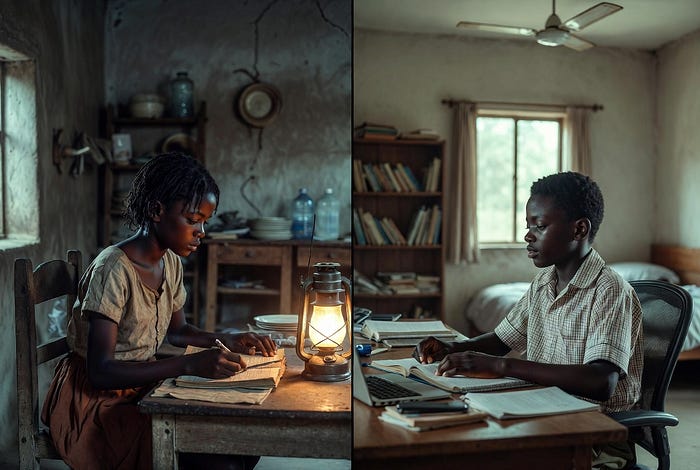
Two Children, One Country, Infinite Distance
The comparison between Adaeze and Emeka reflects the reality of many children in Nigeria. A 2025 study on the influence of poverty (socioeconomic status) on access to learning resources and academic performance in early childhood education found that household poverty is one of the strongest predictors of educational non-participation, dropout, and underperformance. Children in low-income households are not merely disadvantaged at school. They arrive at school already exhausted by the demands of their poverty on their time, sleep, nutrition, and mental bandwidth.
Several studies in cognitive science have shown that sleep deprivation impairs memory consolidation, attention, and executive function, which are the cognitive capacities that academic learning demands. A child who has been hawking since 6:30 am, sitting through six hours of school, hawking again in the afternoon, and helping in the shop until 10:00 pm is not a child who can perform at cognitive peak during a mathematics lesson. She is a child performing an act of extraordinary will against the active resistance of her body and her circumstances. The system that grades her performance against Emeka’s and attributes the gap to intelligence or effort is measuring advantage rather than merit.
UNICEF Nigeria and the National Bureau of Statistics (NBS) estimate that about 64% of children aged 36–59 months do not attend any form of organized early childhood education. In some regions and among the poorest households, the non-participation rate exceeds 90%. This means millions of children arrive at primary school without the foundational cognitive and social preparation that early childhood education provides. In the same country, private nursery schools in upscale urban areas offer Montessori curricula, English immersion, and structured play designed around child development research. The educational race does not begin at the same starting line. One group of children begins kilometres ahead.
The Failure of Infrastructure
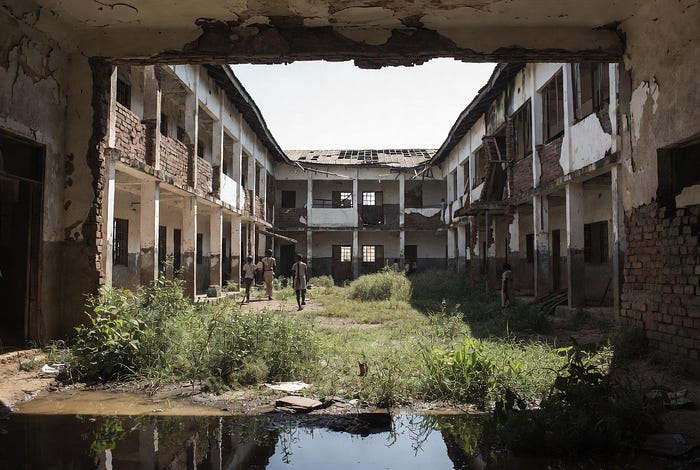
An average Nigerian public primary or secondary school doesn’t resemble a proper learning environment. While defending the Ministry’s 2026 budget defense before the National Assembly’s Joint Committees on Education, the Minister of Education, Dr. Maruf Tunji Alausa, said that Nigeria’s 13,921 public secondary schools are struggling with “severe infrastructure deficits”, including Unity Colleges that are over fifty years old and have never been comprehensively renovated. About 59% of these schools lack basic drinking water, and, according to UNICEF Nigeria, only 11% of schools nationwide have full access to basic Water, Sanitation, and Hygiene (WASH) services. Only 39% of Nigerian primary schools currently have access to electricity, and only 11% have internet access.
UNESCO and the Global Partnership for Education recommend a maximum of 40 pupils per teacher, and the National policy on Education prescribes a student-teacher ratio of 1:25 for pre-primary classes, 1:35 for primary, and 1:40 for secondary schools. However, the national average pupil-to-teacher ratio in public primary schools is around 1:46 to 1:48. In northern Nigeria, particularly the North-West, ratios are significantly higher. Some reports indicate average class sizes of 101 pupils per teacher in states like Katsina. In extreme cases, education officials have reported ratios as high as 1:300 or more in certain underserved schools.
The 2025 education budget allocated N3.52 trillion, the highest nominal allocation in history, and yet the Ministry of Education reported a capital budget performance rate of just 5.8%: only N19.5 billion of the N335.2 billion approved capital budget was actually disbursed. The infrastructure money was budgeted, but for some reason, it was not released.
Nigeria’s 2025 education budget included a N290 billion shortfall in teacher salaries alone, the gap between the N1.64 trillion allocated for personnel costs and the N1.93 trillion required to pay all teachers the national minimum wage of N70,000 per month. The N290 billion shortfall is mirrored at the state level, where the N70,000 minimum wage remains a major point of friction. As of early 2026, the Nigeria Union of Teachers (NUT) reported that several states had still not implemented the N70,000 wage for teachers, including Abia, Adamawa, Ebonyi, Gombe, Nasarawa, Yobe, and Zamfara. In many states, teachers, especially those at the local government level, were still being paid outdated wages of N18,000 or N30,000, creating a massive disparity between approved budgets and actual bank alerts. Even for states with high “nominal” allocations, the average execution rate is only 66.9%. This means nearly one-third of the money approved for education, including teacher welfare, never leaves the state treasury. Teachers who are not paid adequately do not show up. A classroom with a physically present but mentally exhausted, financially distressed teacher is not substantively different from a classroom with no teacher. And the children like Adaeze sitting in it are exhausted, hungry, half-asleep, so they receive the full compounding burden of both her poverty and the system’s poverty.
A 2026 report by the UNESCO Institute for Statistics (UIS) and the African Centre for School Leadership reveals that learning levels in Africa remain persistently low. For Nigeria specifically, 36% of Nigerian primary school pupils achieved minimum proficiency in literacy and numeracy in 2022, the same figure as in 2019. However, recent findings indicate that as few as 9.5% to 30% of pupils reach the minimum proficiency level (MPL) in reading and mathematics by the end of primary school. UNICEF reports that 70% of 10-year-olds in Nigeria cannot read with meaning or solve simple math problems. Nigeria, with its ambition to become Africa’s leading economy, is producing primary school graduates who, in the majority, cannot read or calculate at the level expected of their age. And the responsibility for that failure is not with children or teachers, but with every government that has chosen debt servicing, security votes, and political overhead over the foundational investment that education requires.
The Cruelty of Meritocracy Without Equity
Here is an argument you will rarely hear in Nigerian education policy discussion, because it challenges a deeply held cultural mythology: the scholarship system, as currently designed, is structured primarily to reward children who are already winning, rather than to rescue children who are drowning.
Federal Government scholarships, state bursaries, and most institutional awards are almost universally merit-based. They are awarded to students who achieve the highest academic scores. On the surface, this seems fair. However, in practice, it is a system that takes the children who have already benefited from the best schools, the most stable home environments, tutors, textbooks, uninterrupted sleep, and well-fed mornings, and rewards them with additional resources. It systematically excludes children like Adaeze, whose grades are average, not because she is not capable, but because she has been set an impossible task: to perform at the highest academic level while simultaneously bearing the economic weight of her household.
Academic performance is not a clean measure of intellectual potential but rather a measure of that potential plus access to the conditions that allow it to be expressed. A child who scores 60% while hawking for five hours a day, sleeping six hours a night, attending a school with a 1:100 teacher ratio, and doing homework by candlelight has demonstrated more raw intellectual capacity than a child who scores 75% in a comfortable environment with tutors and reliable electricity. Yet the scholarship goes to the 75%, every time. The 60% child is told that she was simply not good enough, and the structural reasons for the gap are never interrogated.
The argument for need-based scholarships, awards structured around financial need rather than academic ranking, is not an argument against excellence. It is an argument for giving excellence a fair chance to emerge. Countries like South Korea, Finland, and Brazil, which have made the most dramatic improvements in educational equity over the past three decades, have done so not by identifying the top performers and rewarding them further, but by raising the floor for children at the bottom. They recognised that talent is distributed equally across socioeconomic classes, even if opportunity is not. Nigeria, with millions of children of Adaeze’s ability trapped in structural poverty, cannot afford to continue selecting its investment based on the outcomes of an inherently unequal competition.
The average student deserves a particular mention here, because she is the child the Nigerian education system is most content to ignore. Excellence-focused policy fixates on the top performers, the students who will win prizes, attend federal government colleges, and feature in convocation highlights. But the vast majority of Nigerian students are average students. They are the solid, capable, unremarkable majority who will constitute the backbone of the working population. When those students are given inadequate teachers, crumbling infrastructure, no financial support, and no institutional attention because their grades are not spectacular enough to attract notice, the loss is not only theirs but the economy’s, the nation’s, and the future’s. A country that invests only in its top 5% has written off 95% of its human capital.
NELFUND: A Real Step On An Incomplete Road
President Bola Tinubu signed the Student Loans (Access to Higher Education) (Repeal and Re-enactment) Act on April 3, 2024. By November 12, 2025, the fund had surpassed 1 million applications, with approximately 1.19 million received from inception. As of March 9, 2026, NELFUND says it has disbursed a total of N206.29 billion to 1,164,222 students from 1,753,868 applications received across roughly 270 public tertiary institutions.
The best graduating student at LAUTECH, Caleb Oladepo, who grew up in a village in Osun State, publicly attributed his academic success to NELFUND, triggering a national conversation about whether the programme was making a real difference. NELFUND is, and I will acknowledge this clearly and without any hesitation. However, this acknowledgement is not the same as sufficiency. NELFUND has several foundational limitations that prevent it from being the transformative intervention that Nigeria’s education crisis actually requires.
First, NELFUND provides loans for tuition and upkeep at universities, polytechnics, and vocational institutions. It does not touch primary school, secondary school, or the 18.5 million out-of-school children who will never reach tertiary education. The child who drops out at JSS 3 because her family cannot afford the pay, the uniform, or the cost of lost hawking income is not reachable by NELFUND. The programme begins its intervention at the point in the educational pipeline where the most disadvantaged have already been excluded.
Second, NELFUND offers interest-free loans, which is a genuine improvement over previous iterations, but repayment begins after employment. In a country where graduate unemployment has exceeded 33% in recent years, the ability to repay is deeply uncertain for students from low-income backgrounds. As of late 2025, youth unemployment in Nigeria remains critical, with some reports citing rates nearing 50% for certain age brackets. A 2024 NBS insight clearly stated that 1 in 3 graduates in Nigeria remains unemployed even a year after graduation. The British Association for International and Comparative Education (BAICE) had warned in September 2024 that NELFUND risks creating a “debt-ridden generation.” They argued that by shifting the cost of education to families through loans in a “job-starved economy,” the policy could exacerbate inequalities rather than resolve them.
Third, and most importantly, a loan is not a scholarship. Students who cannot afford education should not be required to pay for it or borrow to access it. A scholarship is a statement that a child’s right to education should not be contingent on her family’s financial position. A loan is a deferred payment, but it still does not remove the financial barrier. It simply moves it to a later date, when the former students are in a labour market that may have no room for them.
What Does Nigeria’s Education Budget Tell Us About Its Priorities?
In 2015, education received 10.75% of the national budget. By 2025, that share had fallen to 5.47%, a decade-long decline in the sector’s real priority, even as the nominal figures rose in naira terms. The 2026 budget proposes only a 6.1% allocation to education, less than half of UNESCO’s minimum recommendation. Only N19.5 billion of the N335.2 billion capital budget was disbursed in 2025, a 5.8% release rate, meaning that 94.2% of the money meant to build and equip schools never left the treasury. A total of 27 states could not access a combined N54.9 billion in UBEC (Universal Basic Education Commission) funds in 2024 because they could not meet the 50% co-funding requirement, which is another way of saying that the states where children are poorest are the states that also cannot afford to meet federal matching conditions, and so their children receive nothing.
Against this backdrop, the government of a country where 18.5 million children are out of school, 15% of the global total and where fewer than 40% of students who begin primary school complete secondary education, cannot credibly speak of investing in the future. Nigeria speaks of education constantly and ritually commits to it at every budget presentation, every policy dialogue, and every UNESCO review. But a government’s commitment to education is not measured in speeches. It is measured in classrooms, teachers, books, and the percentage of a national budget that a government is willing to sacrifice from other priorities, including the political overhead, the security votes, and the debt servicing that now consumes 32.8% of the federal budget alone, to give its children the conditions in which to learn.
The ordinary Nigerian child does not ask for very much. She asks for a safe building to sit in, a teacher who is present and paid, a textbook she does not have to share with two other people, light to read by at night, security on the road to school and the assurance that if she works hard, her grades will reflect her effort rather than her exhaustion. These are not extraordinary demands but the minimum conditions of a functioning education system.
What A System Built For Adaeze Would Look Like
An education system genuinely built for the ordinary Nigerian child would make several structural departures from the current model, not incremental adjustments, but fundamental reorientations of both financing and philosophy.
That system would immediately implement need-based scholarship and bursary programmes. Every state government would have a tiered bursary system for secondary school students, not the highest scorers, but the most financially vulnerable. Federal scholarships would reserve at minimum 50% of their awards for students below a defined income threshold, regardless of grade ranking. The brilliant child of a wealthy family has options, but the average child of a poor family has none. Equity demands that the state prioritise the latter.
The out-of-school crisis cannot be addressed with tertiary loan programmes. It requires a genuine reinvigoration of the Universal Basic Education Commission with full disbursement of UBEC funds, removal of the punitive co-funding barrier for poor states, and community-based re-enrollment programmes that work around the economic realities of child labour rather than pretending those realities do not exist.
Such a system would close the N290 billion teacher salary gap immediately, and treat teacher welfare as a non-negotiable baseline rather than a residual allocation. Teachers who are paid, present, and professionally supported are the single highest-return investment available to the Nigerian education system. A classroom with a well-paid, well-trained, motivated teacher can overcome significant infrastructure deficits. A classroom with a demoralised, absent, underpaid teacher cannot be redeemed by new furniture.
That system would reform NELFUND into a hybrid instrument by maintaining interest-free loans for those who can realistically repay them, but creating a non-repayable grant tier for students from households below the poverty line. It would legislate education spending as a constitutional obligation. The Abuja Declaration (health) and UNESCO benchmarks (education) have been ignored for decades because they are political commitments rather than legal ones. An amendment to Nigeria’s Constitution to establish a minimum education budget floor, as several progressive jurisdictions have done, would remove the annual discretion that allows governments to deprioritise education when competing political spending is at play.
None of this is impossible. The question is not whether Nigeria can afford to educate its children. Nigeria, with revenues now climbing to over 11% of GDP, has more fiscal space than it has had in years. The question is whether Nigeria will choose to spend that fiscal space on the generation that will inherit the country or on the generation that currently runs it.
Conclusion
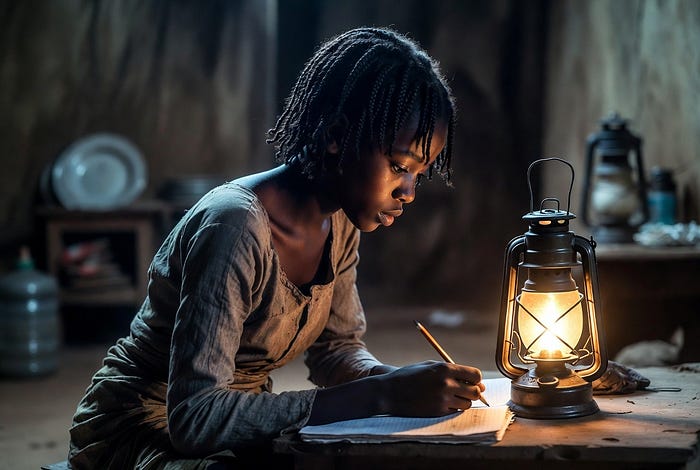
Every night, after the shop closes, after the plates are washed and the water is fetched, Adaeze opens her exercise book. She does this not because the system has made it easy, not because anyone has engineered the conditions for her success, but because she has decided against every structural signal that her effort does not matter, that it does. She is wrong about one thing, though; it matters enormously. But she is right about something more important. She has not given up.
The question this article puts to Nigeria’s government, to its legislators, to its policy architects, and to its budget committees is simple: when will you match her effort? When will the system that claims to be built for her future actually begin to carry some of the weight she has been carrying alone? When will the child who hawks at 6:30 am and does her homework at 11:00 pm be told not in a presidential or governor’s speech, but in a school with a functioning laboratory and a paid teacher and a scholarship that asks about her need rather than only her grades — that she was not wrong to believe that education was her way out?
The system was never built for her. It still isn’t. And that, more than any budget number or examination result or policy target, is the true state of education in Nigeria in 2026.
Comments
No comments yet.