The System Was Never Built For You: How Nigeria’s Health System Is Failing The Ordinary Nigerians
Ayodeji Aladejana · 2 May 2026
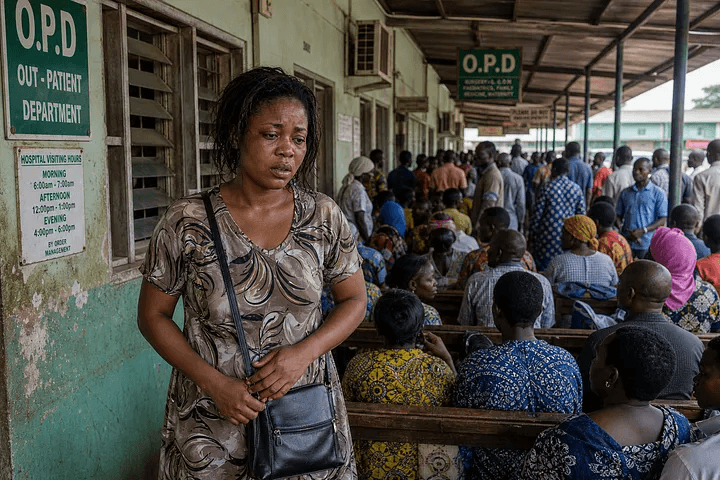
Imagine you wake up somewhere in Beere, Ibadan, with a fever that has kept you awake for three nights. Because you can not take one more day of that kind of discomfort, you decided you would rather take the money you have been saving towards your rent to get treatment at the nearest government health facility. You get dressed, take an okada, and arrive at the OPD of the closest Government Hospital around 7:15 a.m., where you join a queue of 47 people.
The doctor who should attend to you is not around; she relocated to the UK six months ago, and a replacement has not been hired. The one doctor available is seeing patients in a ward meant for twenty but currently housing thirty-three. Around midday, you finally got to see a doctor who ordered some tests. After your blood sample was collected, you were asked to wait. While you waited, you overheard one of the laboratory scientists tell her colleagues that the laboratory did not have enough reagents to carry out the tests that had been ordered. The pharmacy does not even have drugs to dispense; whatever prescriptions the doctor gives other patients, they have to buy the medications themselves. Feeling defeated, you chose to leave. Now you are leaving sicker than when you arrived, having paid a registration fee, a consultation fee, and a diagnostic fee out of your own pocket for results that told you nothing and treatment you still could not access.
While this sounds like a hypothetical scenario constructed for rhetorical effect, it is, unfortunately, the lived reality of millions of Nigerians every single day. And the cruel paradox at the heart of it is that the system failing them is not a system in collapse but a system functioning precisely as it was structured, to serve the rich and the elites, but not the ordinary Nigerian.
Health Financing Illusion
In 2001, African heads of state gathered in Abuja and made a solemn commitment that each signatory government would allocate at least 15% of its annual national budget to the health sector. Nigeria was there and signed. Twenty-five years later, Nigeria has never met that target, not even once.
In 2025, Nigeria’s health sector received ₦2.83 trillion, about 5.14% of the total budget of ₦54.99 trillion. The 2026 budget allocated ₦2.48 trillion, 3.62% of the proposed ₦68.32 trillion, to health. To put that into perspective, the federal government plans to spend ₦12,400 ($8.85) per person for the entire year, compared with the $82.75 (₦115,850) per person annually needed for adequate care. In 2026, a single cup of tea costs more than what the Nigerian government will spend per citizen on healthcare in an entire day (₦34).
Out of the health budget that is allocated, 75% goes to recurrent expenditure, usually salaries and overhead costs, leaving roughly 25% for capital investment in infrastructure, equipment, medicines, research, and others.
The consequence of this underfunding falls, as it always does, on the average Nigerian. Because the government will not pay, Nigerians must now pay themselves. On average, households in Nigeria pay 71% of their total health expenses out of pocket, and out-of-pocket spending accounts for 58.3% of total health expenditure. This imbalance has created a system that forces families to choose between eating and seeking medical care routinely. An estimated 15% of households in Lagos alone routinely suffer catastrophic health expenditure, that is, they spend more than 10% of their respective household’s total income on healthcare.
The Architecture of Inaccessibility
Across the country’s 36 states and FCT, the primary healthcare infrastructure, which is the first point of contact for the ordinary Nigerian who cannot afford private hospitals, is characterised by dilapidated physical structures, chronic shortages of essential medicines and diagnostics, irregular power supply, absent running water, and, increasingly, no staff.
A critical review of the quality of Nigeria’s healthcare system by Josiah et al. (2025) found that 74% of respondents rated the structural quality of government healthcare facilities as “poor” or “very poor.” More than 88% cited the lack of essential medicines as a major challenge. Over 90% identified inadequate staffing. These are not the discontents of an entitled few but documented assessments of a population surveyed across over a decade of interactions with the system. And yet 87% of those same respondents still used government facilities because the private alternative, however superior in quality, is financially impossible for most.
The Basic Health Care Provision Fund (BHCPF), established under the National Health Act 2014 as a dedicated financing mechanism for primary healthcare, has, as of September 2025, disbursed over ₦192 billion to states and the FCT since its inception. Subsequent disbursements in late 2025 and early 2026 have significantly increased this total. Yet clinic visits in rural communities tell a different story. Many of these primary healthcare centres are still underfunded, understaffed, and under-equipped, their BHCPF allocations swallowed by administrative overhead, delayed by bureaucratic dysfunction, or simply not reaching the facility level. The architecture of accountability between federal disbursement and community-level delivery remains one of the most consequential unsolved problems in Nigerian health governance.
The picture is most devastating for women. Nigeria’s maternal mortality ratio, approximately 1,047 deaths per 100,000 live births, according to recent WHO estimates, is among the highest recorded anywhere in the world. The Sustainable Development Goal target is 70, and the global average is below 200. To be a woman giving birth in Nigeria is to face statistical odds of death that are more than ten times worse than the international development standard. Northern states experience maternal mortality rates up to five times higher than southern states, a disparity that makes visible the brutal intersection of geographic, economic, and gender inequality embedded in the health system’s architecture. One in every thirteen Nigerian children born does not survive to their first birthday.
The Hemorrhage of Human Capital
A health system is, at its core, its people. Buildings can always be rehabilitated, equipment can be procured, medicines can be stocked, but doctors, nurses, midwives, and pharmacists take over a decade to train. They are leaving Nigeria at a rate that now constitutes a genuine national emergency.
The phenomenon Nigerians call “Japa” has reshaped the health workforce landscape at an alarming pace. According to data disclosed by the Coordinating Minister of Health and Social Welfare, Professor Muhammad Ali Pate, in March 2024, Nigeria lost between 15,000 and 16,000 doctors over the preceding five years. In 2023, the UK’s General Medical Council records 12,198 Nigerian doctors were practising in Britain alone, and latest reports suggest this number has continued to grow, with over 4,600 migrating since May 2023. A 15-year cohort study by Wariri et al. (2024) found that 48.9% of graduates from a major Nigerian medical school had migrated within 15 years of qualification, with the United Kingdom (48.5%), Canada (20.9%), and the United States (19.4%) as the main destinations, a finding of such gravity that it is difficult to overstate its implications for the future of the health system.
The nursing exodus has been, if anything, more severe. In May 2023, the National Association of Nigeria Nurses and Midwives stated that over 75,000 nurses and midwives had left the country. The Nursing and Midwifery Council of Nigeria’s own registrar reported that over 15,000 nurses left in 2023 alone. In December 2023, a federal lawmaker disclosed that five wards comprising approximately 150 beds had been shuttered at the Lagos University Teaching Hospital, a tertiary institution that is meant to represent the apex of Nigeria’s public health system, due to a shortage of healthcare workers.
Nigeria’s doctor-to-patient ratio stands at approximately one doctor per 10,000 people, compared with a WHO-recommended minimum of one per 600. The healthcare workers who remain are overworked to the point of clinical danger, operating in underfunded facilities with obsolete equipment, and receiving salaries that are inadequate by any measure. The system’s response to the emigration crisis has, until very recently, been punitive rather than structural. At some point in 2022, some lawmakers proposed an amendment to the Medical and Dental Practitioners Act. The proposed amendment contained provisions that will compel doctors to practise in Nigeria for five years after qualification. This proposal was widely and rightly condemned because it addresses the symptom and not the disease.
The root causes of the “japa” wave are poor remuneration, hostile working conditions, inadequate equipment, lack of professional development opportunities, insecurity, and the lived experience day after day of trying to heal people in a system structurally designed not to support that effort.
Health Insurance: A Promise Never Kept
Nigeria launched the National Health Insurance Scheme (NHIS) in 2005 with the stated goal of achieving universal healthcare access by 2015. It is now 2026, eleven years after the original target, and fewer than 5% of Nigerians are enrolled in any form of health insurance. The NHIA (National Health Insurance Authority, reformed from the NHIS under the 2022 NHIA Act) announced in 2024 that it had enrolled 19.4 million Nigerians, representing a 14% year-on-year increase. In a country of over 220 million people, that represents less than 9% coverage, and even that figure counts many who are enrolled in name but whose entitlements remain difficult to access in practice.
The structural consequences of near-zero insurance penetration are total. When 95% of the private health sector’s financing comes from out-of-pocket household payments, the financial risk of illness falls entirely on the individual and the family at the worst possible moment. There is no buffer, no pooling of risk, no mechanism by which the healthy and the wealthy subsidise the sick and the poor, as health insurance systems are designed to do. In this environment, a serious illness is not merely a health crisis but an economic catastrophe.
The failure of health insurance is partly due to poor administrative enrolment infrastructure, complex claims processes, and resistance from healthcare providers, but it is fundamentally political. Universal health coverage requires government commitment to financing the premiums of the uninsured poor through general taxation. In a country where the government contributes only 12.4% of total health expenditure, that commitment does not exist at the necessary scale. The Coordinating Minister of Health has set an ambitious target to cover 44 million Nigerians with health insurance by 2030. Whether it is matched by the financing and institutional resolve required to achieve it is a question that Nigerian health advocates are right to press.
The Aid Withdrawal Crisis
In January 2025, the administration of United States President Donald Trump announced the suspension and effective termination of USAID programmes, froze PEPFAR (the President’s Emergency Plan for AIDS Relief), and announced America’s withdrawal from the World Health Organisation. For Nigeria, which had relied on American development assistance for decades to fund critical health interventions, the impact was immediate and severe.
In 2023 alone, Nigeria received more than $600 million in US health assistance, accounting for over one-fifth of our annual health budget. USAID-backed programmes had funded antiretroviral therapy for 89% of the nearly two million Nigerians living with HIV, protected 68 million Nigerians from malaria through mosquito net distribution and treatment programmes, and underwritten maternal and child care, family planning, tuberculosis control, and laboratory surveillance systems. The sudden withdrawal of this funding created a budget gap that threatened to reverse decades of hard-won progress in some of the most critical areas of public health.
According to preliminary data released by the Organisation for Economic Co-operation and Development (OECD) in 2025, official development assistance from the world’s wealthiest nations fell by 23.1% in real terms that year, the largest annual decline in the entire recorded history of foreign aid. Five major donors, the United States, Germany, the United Kingdom, Japan, and France, accounted for 95.7% of the total decline. The OECD projects a further 5.8% decline in Official Development Assistance (ODA) in 2026. The era when Nigeria could outsource approximately one-fifth of its health budget to external donors is, by all available evidence, over.
The Nigerian government responded by creating a supplementary health budget of $200 million directed toward immunisation and epidemic response, a multi-ministerial committee to develop a transition plan for USAID-funded programmes, organized a four-day National Policy Dialogue in Abuja in September 2025 themed “Reimagining the Future of Health Financing in Nigeria”, and participated in the Accra Health Sovereignty Summit, where African leaders called for “health without aid.” While these are serious policy signals, they are unfortunately not yet serious financing commitments at the scale the crisis demands.
The era of Nigeria outsourcing one-fifth of its health budget to foreign donors is over. The question is not whether Nigeria can build a self-reliant health system. It is whether its government has the political will to pay for one.
What A System Built For You Would Look Like
The argument of this article is not that reform is impossible or that nothing has improved. There have been meaningful institutional developments. The NHIA Act 2022, for example, is a genuine restructuring of the health insurance framework. The Nigeria Health Sector Renewal Investment Initiative, launched in 2023, also established a coherent sectoral framework aligned to government priorities. The free emergency caesarean section policy introduced in late 2024 was a concrete pro-poor intervention that acknowledged, at the highest level, that cost was killing women. Progress exists, and it is real. However, it is nowhere near enough.
A health system built for the ordinary Nigerian would look completely different from what currently exists. It would allocate at least 15% of the national budget to health, not as a rhetorical aspiration invoked at every policy dialogue, but as a binding, auditable constitutional obligation. It would treat health insurance not as a voluntary benefit for formal-sector workers but as a universal entitlement, financed by the state for those who cannot afford premiums. It would invest in primary healthcare facilities at the ward and local government level with the same seriousness currently reserved for tertiary teaching hospitals in state capitals. It would address the conditions like compensation, infrastructure, and professional dignity that are driving its healthcare workers to leave, rather than attempting to legislate them into staying.
It would also end the practice of medical tourism. Every year, Nigeria’s leaders, the very officeholders responsible for the state of the health system, travel abroad for medical care that the system they oversee cannot adequately provide. The irony is not merely bitter but also structurally important. When political decision-makers are insulated from the consequences of their own health policy failures, the incentive to fix the system diminishes. A political class that used Nigerian hospitals would have a very different relationship to the question of whether Nigerian hospitals work.
Finally, a health system built for the ordinary Nigerian would recognise, as a matter of political philosophy, that health is not a commodity to be purchased by those with resources, but a constitutional right guaranteed to every citizen. Section 17(3)(d) of the 1999 Constitution already provides the framework: the state is obligated to ensure that adequate medical and health facilities are available for all persons. What is missing is not the legal architecture but the political will to allocate a budget to that architecture.
The Reckoning That Cannot Be Deferred
The average Nigerian in the queue at the government health facility at around 7:15 a.m., who paid his own money for the privilege of waiting hours to receive no treatment, is not a passive victim of an impersonal system. Every Nigerian is the subject of a set of political choices made by our government. Our government has made its choice about what to fund, what to build, who to train, who to retain, and what to owe to citizens in exchange for their taxes and their trust. Those choices have been made, repeatedly and consistently, in ways that do not serve an average Nigerian.
The aid withdrawal simply brought this reckoning to a head. For decades, the gap between what Nigeria’s government was willing to spend on health and what Nigerians actually needed was partially concealed by donor funding. That concealment is no longer available, so the government must now confront, without the diplomatic cover of foreign generosity, the question of whether it intends to finance a health system that actually works for the people who most need it.
The answer, over the next three to five years, will not be written in policy documents or budget speeches. It will be measured by maternal mortality rates, the number of doctors who remain rather than leave, and the proportion of Nigerians who can see a doctor without selling something to pay for it. It will be written in the experience of the average Nigerian in the queue at around 7:15 a.m, and whether, for our offspring, the system will finally be built to serve us.
Comments
No comments yet.