
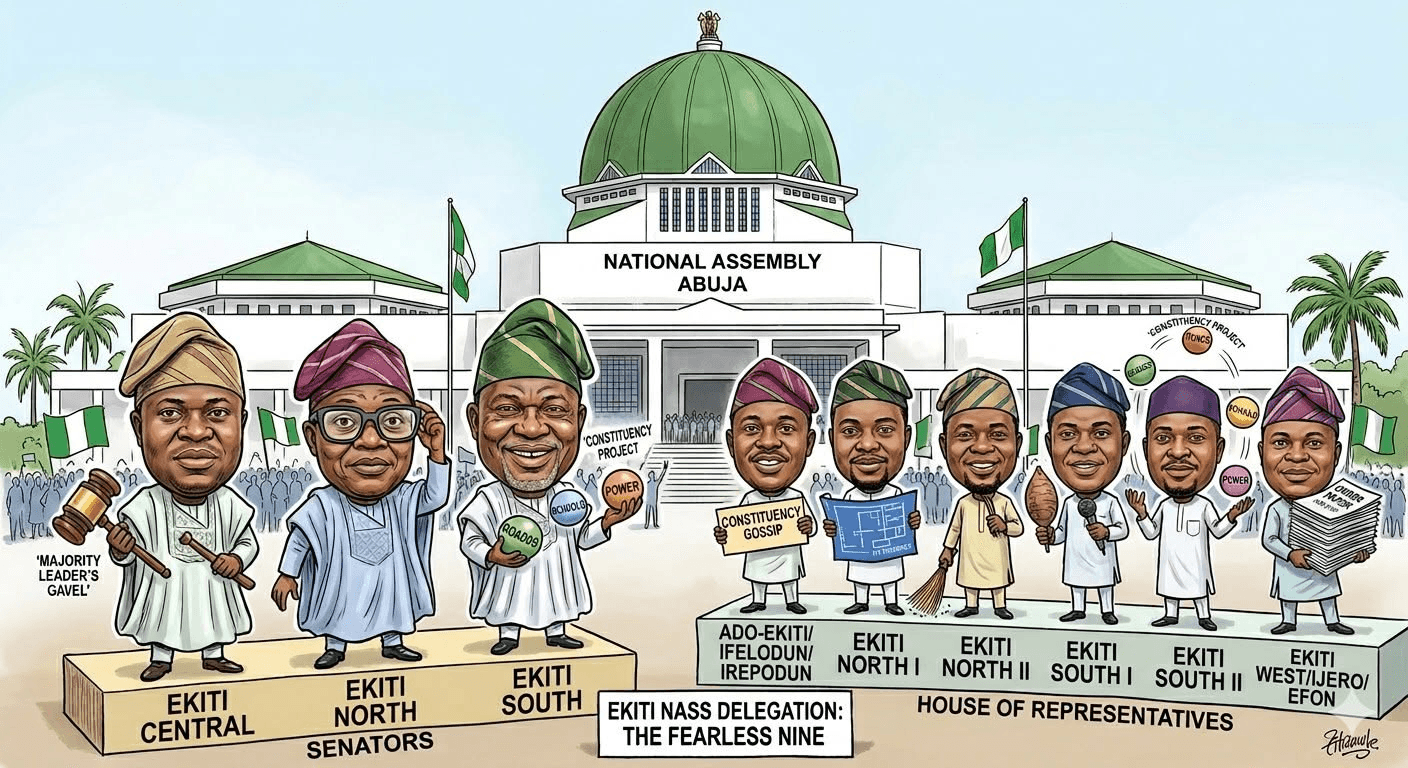
What Has The Nine Legislators Ekiti Sent To Abuja Brought Back From Abuja?
Ayodeji Aladejana · 6 April 2026
Ektii Kete,
I want to have an honest conversation with you today. This is not a lecture or a political manifesto. It is just a conversation you would have with someone you trust, sitting somewhere quiet, speaking plainly about something that has been bothering you for a while, because this has been bothering me for a while.
You have probably heard the murmurs and quiet talk making its way through party circles and political WhatsApp groups about the possibility of giving Ekiti's federal lawmakers, all nine of them, or most of them, automatic tickets into the 2027 elections. The argument being offered, for those who have not heard it framed this way, is essentially a strategic one. Some of these lawmakers hold committee positions in the National Assembly, or are positioned to hold even more influential ones in the next assembly. Replacing them, so the argument goes, would cost Ekiti those positions and reduce the state's influence at the federal level. So the logic is: leave them where they are, protect the seats, and let the seniority work for us.
I understand the argument, I genuinely do. In Nigerian politics, committee chairmanships and ranking member positions are real instruments of power. They determine budget allocations, oversight authority, and access to the executive arm of government. But here is the question I keep coming back to: what has that influence actually produced for the people of Ekiti? Not in Abuja, but here in our communities?
First, let's talk about what a lawmaker's job actually is…
I think part of the problem is that many of us, including myself, have quietly lowered our expectations of what a federal lawmaker is supposed to do. We have accepted a version of representation that is so diminished, so reduced in ambition, that we no longer even demand the actual job. So let me remind us of what the job is.
A federal lawmaker is primarily a legislator. Their most fundamental product is a bill, a piece of proposed law that, when passed, changes something in the country or protects something for its citizens. Before the empowerment events, before the campaign rallies, before the photographs with ministers, the bills come first. A lawmaker who is not sponsoring or substantially shaping legislation is, in the most technical sense, not doing their job. They are simply occupying a seat.
Now I want to ask you something. In the nearly three years since our nine federal lawmakers were inaugurated in June 2023, can you name, off the top of your head, a single bill that any of them sponsored that you heard about, discussed, or felt the impact of? Not a bill they co-signed after someone else did all the work, or a motion. I mean an actual bill, bearing their name, that addresses real problems faced by the people of Ekiti, such as unemployment, energy poverty, agricultural underdevelopment, and the lack of federal institutions that have progressed meaningfully through the National Assembly?
I am not asking to embarrass anyone. I am asking because this is the baseline. This is the floor of the job description. And if the honest answer, for most of them, is that you cannot think of one that you have not once sat at your table in Omuo or Iyin or Iropora and heard about a bill your federal lawmaker introduced that spoke directly to your life, then that tells us something important about the quality of representation we have been receiving.
Let us talk about the projects, because this is where I expect the pushback to come. Some of them will point to things like renovated school buildings, installed transformers, solar street lights, boreholes, health centre upgrades and say, "We brought development." So I want to engage that honestly rather than dismiss it.
If a school in your community has been renovated, that is significant. If a borehole has been sunk in a village where people used to walk long distances for water, that matters to the people who use it. I am not here to tell anyone that those things are worthless. But I want us to think carefully about the scale of what we are being offered versus the scale of what was possible.
A federal lawmaker is not a local government chairman. They are not supposed to be sinking boreholes and renovating primary school blocks as their headline achievements. Those are local government interventions that are important, but far below the threshold of what a federal mandate is designed to produce. A senator or House member with access to federal appropriations, federal ministries, and federal agencies, and the full weight of the national budget cycle, should be attracting initiatives that permanently change the economic architecture of their constituency. Federal roads, institutions, industrial or processing zones, electrification infrastructure and the kind of projects that will still be generating jobs and economic activity twenty years after the lawmaker who attracted them has retired.
And on electricity, I want to specifically mention this, because it is personal to many of us. A significant portion of Ekiti State lacks stable electricity. I am not talking about occasional outages but permanent, structural darkness. Communities across the three senatorial districts go weeks and sometimes months without power. We have federal lawmakers in both chambers of the National Assembly who are ranking members and serve as principal officers of their respective chambers; some of them are sitting on energy-related committees. We have senators and House members who walk past the offices of the Rural Electrification Agency, the TCN, and the DisCos every single week. What have they said in those offices about the communities back home? What questions have they raised in committee hearings? What oversight visits have they conducted? What letters have gone from their offices to the Ministry of Power specifically about Ekiti's energy deficit?
If the answer is that you do not know because nothing they did in those spaces was visible enough to reach you, then the question worth asking is whether they did anything at all.
Can we also talk about empowerment events? Because I think we need to have an honest conversation about what these are and what they are not.
I have nothing against a lawmaker distributing items to their constituents. If someone receives a grinding machine, a sewing machine, or a bag of rice from their representative, I am not going to tell them to return it. People are suffering, and any relief matters in the immediate moment.
But here is my concern. The empowerment event has become, for many of our lawmakers, a substitute for actual constituency work rather than a supplement to it. It has become the thing they point to when asked what they have done. And there is something deeply troubling about a political culture in which a senator who earns millions of naira monthly in salaries, allowances, and constituency funds believes that distributing grinding machines to a few hundred people in an election year constitutes a record of service.
Think about this with me: if even a portion of the constituency fund that has passed through the hands of our federal lawmakers over three years had been, for example, deployed as a structured, endowed, competitive, merit-based scholarship programme administered by a committee of credible people. How many Ekiti students would currently be in university because of it? How many of those students would be the first in their families to access tertiary education? And that scholarship would still exist next year, and the year after, whether the lawmaker is reelected or not.
That is the difference between development and the management of poverty. One lasts while the other photographs well and disappears.
Here is something I want you to think about. In the nearly three years since our federal lawmakers were inaugurated, how many of them have held a structured town hall meeting in their constituency? Not a rally or a campaign event where people are bused in and given T-shirts, or a press conference or even a town hall where constituents are genuinely invited to come, ask questions, raise problems, and receive direct answers about what their representative has been doing in their name.
I am talking about the kind of event where a lawmaker stands before the people of Ikoro or Itapaji or Aisegba and says: "Here is what I have done. Here is what I tried but could not do. Here is where your money went. Ask me anything."
Because the pattern I have observed, and I suspect you have observed it too, is that the only time most of these lawmakers appear before significant numbers of their constituents is when they need something. It is either a rally, a mobilisation, or a show of the crowd. They appear when they are the ones making demands of the people, not when the people are making demands of them. And then the election comes, and suddenly they are everywhere in your local government, in your church, in your mosque, in your community association. You are expected to forget the three years of absence and reward the three weeks of visibility.
I am not asking for perfection. I am asking for the most basic element of democratic accountability. I am asking them to show up for the people who sent them, not just when they need them (the people) to keep sending them (the legislators).
One of their numerous inefficiencies that genuinely pains me is their choice to abandon the youth constituency. Ekiti produces remarkable young people. We know this. The state punches well above its weight in terms of the quality of young Nigerians it sends into national and international spaces, be it fellowships, scholarship programmes, leadership initiatives, health fellowships and even civic programmes. These are young people who compete against thousands across the country and get selected on merit. They carry Ekiti's name into rooms that most of our politicians never enter. They are, in many ways, the best argument for everything Ekiti has always claimed to be. And almost every single one of our federal lawmakers has been completely absent from their lives.
I know this not from a distance. I know it because I have watched young people from this state, brilliant, selected, accomplished, reach out to their federal representatives during their fellowship programmes, seeking the most basic form of engagement: a visit, a conversation, a letter of congratulations, even just an acknowledgement that the lawmaker was aware their constituent had achieved something significant. And what most of them received was silence, unreturned calls or referrals to aides who never called back. The slow, demoralising recognition that the person in Abuja who is supposed to care about their community does not consider them worth fifteen minutes' worth of attention.
Yes, there is one person in our delegation who has been different. One person who has shown up for young people, engaged with fellowships and programmes, and treated the investment in youth as a strategic priority rather than a campaign afterthought. One person whose door has been open, while the rest have been closed.
This matters beyond the personal slight. It matters because the young people selected for fellowships such as the Legislative Mentorship Initiative, the National Health Fellowship, the Mandela Washington Fellowship, and similar programmes are exactly the people who, with the right support and connections, could help build institutions, attract investment, and create opportunities in this state. A senator or House member who identifies these young people, mentors them, connects them to networks, and opens doors for them is not doing charity; they are planting a forest that will grow long after their political career ends. Most of ours have not planted a single tree.
And then there is the job question. Let me be precise about what I am asking and what I am not asking. I am not asking any of our lawmakers to give jobs to unqualified people. I am not asking anyone to bypass the recruitment process or to place political loyalists in federal agencies. I am asking for something far more modest and far more legitimate. I am asking that, when a young person from Ekiti has passed the CBN examination, has cleared the NNPC shortlist, has satisfied every requirement that NITDA or NCC, the Air Force, Navy, Army or any federal agency, is there someone in Abuja who knows that person's name and is willing to say, on their behalf, "This person qualified. Please make sure they are not quietly removed from the list"
That is not corruption but constituency representation. That is what senators and House members do in every functioning democracy on earth. Their offices exist, in part, to ensure that their constituents are not disadvantaged by distance, by lack of connection, or by the simple fact that no one in power knows their name. If our young people are passing federal examinations and still not getting federal jobs at the rates their qualifications should produce, part of the reason, not all of it, but part of it, is that nobody in Abuja is speaking up for them.
To conclude. I am not telling you who to vote for. That is not the purpose of this conversation. What I am asking is that we raise the standard of what we demand before we give anyone our endorsement as a community, as a constituency, as a state.
The automatic ticket argument essentially means that the people of Ekiti should not have a say in whether their representation has been adequate. It is an argument that party structure should override community judgment. It is an argument that the opinion of a few delegates in a primary matters more than the experience of the hundreds of thousands of ordinary people who have lived three years under these lawmakers' representation or absence of it.
I do not think Ekiti should accept that argument. I think Ekiti should do what it has always been known for: think carefully, ask hard questions, and demand a standard of leadership worthy of this state's history and its people's potential.
So here is what I would love for you to do, wherever you are reading this. Think about your own federal constituency. Think about your senator. Ask yourself honestly: in three years, what has changed in my community that I can trace directly to the person I sent to Abuja? What bill do I know about that carries their name? What project exists in my local government that would not exist without their intervention? When did they last stand before their constituents in a setting where they could be questioned, not celebrated, but questioned?
And if the honest answer, in most cases, is that you cannot think of anything, then the conversation about automatic tickets should end right there. Because the automatic ticket is not a reward for service, it is a punishment for a constituency that has not yet demanded service. And the people of Ekiti, educated, proud, and paying attention, deserve better than that.
If this conversation resonates with you, share it. Not to attack anyone. But to start the kind of discussion that should be happening in every local government in this state. The 2027 election is closer than it seems. And the time to set the standard is now, before the campaigns start, before the rallies fill up, before the rice is shared. Ask the question now, while there is still time for an honest answer.
Comments
No comments yet.