Where Nigeria Has Failed Its Women: A Tale of Neglect, Silence, and the Cost of Inaction
Ayodeji Aladejana · 21 March 2026
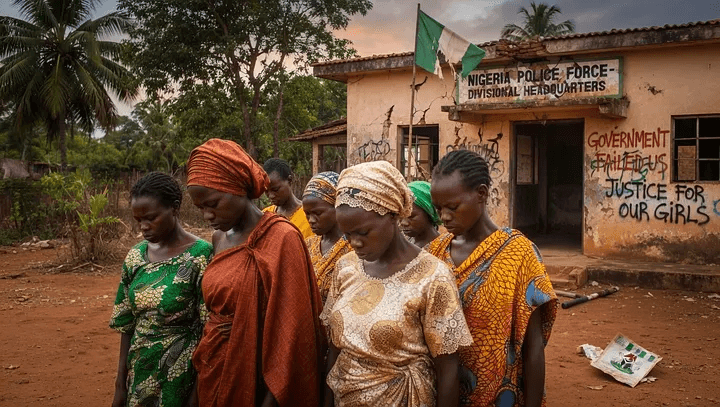
On the 20th of March 2026, videos began circulating on Nigerian social media showing groups of men in Ozoro, a community in Isoko North Local Government Area of Delta State, chasing women down open streets, dragging them to the ground, tearing their clothing, and subjecting them to sexual molestation in broad daylight. In one of the clips, a male voice was heard declaring openly that any woman who stepped outside during the festival period risked being raped, while another clip showed a woman being dragged along the ground by men attempting to tear her clothes as she cried for help.
The response from the Delta State government amounted to mere verbal condemnation. The Commissioner for Works (Rural Roads) and Public Information, Charles Aniagwu, on Friday issued a statement that said that the “Delta State Government has condemned reports of women being harassed and sexually assaulted during the Ozoro Festival, calling the acts barbaric and unacceptable”. The police, to their credit, have arrested five persons, including the community head described as the chief organiser, and transferred the suspects to the State Criminal Investigation Department. These are the correct first steps. But they are also the bare minimum, and they came only after the country’s collective outrage forced the hands of the authorities.
What makes this incident the starting point of this piece is not merely its brutality. It is what it reveals: that in Delta State, a state that has domensticated VAPP Act and has three Sexual Assault Referral Centres, a community wide organised sexual violence against women can happen in a community for what appears to be a recurring period, on the streets of a town where the Delta State University of Science and Technology is located, and the machinery of government does not move until the phones come out and the videos go viral. That is not governance, but a performance of shame after the damage is done. Unfortunately, this is not unique to Delta State. It is, with varying degrees of visibility, the story of most of Nigeria’s 36 states.
Nigeria has 36 states and a Federal Capital Territory. Across all of them, women and children are raped, assaulted, and abused every single day. Yet when the full picture of government response is presented, what you see is not a nation fighting for its women; it is a nation in which most states have done the bare minimum required so they can appear to care. Of the 36 states, only 22 have (at least) one Sexual Assault Referral Centre that provides free medical care to survivors. Fourteen states, Bauchi, Benue, Gombe, Imo, Kano, Katsina, Kogi, Nasarawa, Ondo, Osun, Oyo, Plateau, Rivers, and Taraba, have no government-backed facility where a woman or girl who has just been raped can walk in and receive free medical attention, forensic examination, counselling, or even legal referral. In these states, a survivor must either pay out of pocket, depend on an overstretched NGO, or go without care entirely.
Kano, the most populated state in Northern Nigeria, stands alone as the only state in Nigeria that has not even signed the Violence Against Persons Prohibition Act into law. This means that in Kano, a man who rapes a woman cannot be prosecuted under the most comprehensive legal protection Nigeria has ever produced for its female citizens. These are not administrative oversights but obvious political choices, made by men in power who have calculated that the safety of women is not worth the budget line.
The failure of accountability is perhaps even more disturbing than the failure of healthcare. Across the country, 30 of 36 states do not have an active, publicly accessible sex offender register. This means that in Oyo State, a convicted rapist can walk out of Agodi prison and move into a new community without that community knowing what he has done. In Rivers State, a man who has been prosecuted and convicted for child defilement faces no public record of that fact. In Ondo, Benue, Kogi, Nasarawa, Taraba, Gombe, and Osun, the names and faces of men who have sexually violated women and children are protected by government inaction, while their victims are expected to simply move on.
According to the 2025 Womanity Index, Zamfara, Imo, Oyo, and Katsina (in that order) are the four states with the most critical weaknesses in Gender-Based Violence prevention and response in the country. These states have laws that only exist on paper, machinery that does not move, and survivors who report their assault into a dysfunctional system that does nothing. The national sexual offender register operated by NAPTIP is technically accessible to the public but is fed inconsistently by most states, making it a database that reflects political theatre far more than it reflects justice. When a country’s naming and shaming architecture is real in only three states, Lagos, Ekiti, and Edo, and fictional in thirty-three others, it is not a system but a shameful performance.
Lagos and Ekiti have shown, without ambiguity, that it is possible to build something that actually works. Lagos has the Domestic and Sexual Violence Agency, the Ikeja Sexual Offences and Domestic Violence Court, and a live and searchable sex offender registry updated by the Ministry of Justice. Ekiti has produced the most punitive and creative response to sexual violence of any government in Nigeria. Ekiti State has opened and maintained a Black Book since 2013. The State produces physical posters that bear the full name and faces of convicted rapists, and the posters are pasted in public spaces across the 16 local governments in the state. Ekiti mandates compulsory psychiatric evaluation for offenders where the victim is a child, and also has a cluster of laws that collectively cover domestic violence, sexual violence, and the protection of children.
The former First Lady of Ekiti State, Erelu Bisi Fayemi; the current First Lady, Dr Olayemi Oyebanji; and their Lagos Counterparts, Dame Abimbola Fashola, Mrs Bolanle Ambode, and Ibijoke Sanwo-Olu, have used their platforms, offices, and relationships with civil society to drive these outcomes. They funded campaigns, stood physically beside survivors, and demanded that their states’ legal systems take sexual violence seriously. The contrast with their counterparts in other states is not just stark. It is an indictment.
So the question must be asked plainly, and without politeness, of the wives of the governors of Oyo, Rivers, Ondo, Kogi, Nasarawa, Benue (I understand that the current Governor is a Catholic Priest, but he is responsible for that state and his predecessors had wives), Kano, Taraba, Gombe, Osun, Imo, and Plateau and women who occupy offices of influence, who attend international women’s day events and speak at forums about empowerment what exactly are you doing? What conversation have you had with your husband about why your state has no Sexual Assault Referral Centre? What meeting have you called to ask why a victim of sexual assault in your state must pay for her own treatment or go without? The First Ladies of Lagos and Ekiti did not inherit systems that worked. They fought for them. Their counterparts in the states that lag behind cannot credibly claim ignorance, and, to my understanding, influence without application is complicity by another name.
Beyond the failure of government, there is another silence that must be named: the silence of Nigeria’s religious leaders. This country is home to roughly 200 million people, the majority of whom identify as either Muslim or Christian. Mosques and churches anchor every community in all our cities, towns and villages. The voice of a pastor or imam in any Nigerian town carries more immediate weight than most government pronouncements. And yet, on the question of sexual violence against women and children, that voice has been inexcusably absent. The men who lead Friday prayers and Sunday services, who command the loyalty of millions of worshippers, who fundraise for church buildings and mosque expansions, where are they when a woman in their congregation has been raped? Where are their open letters to governors demanding Sexual Assault Referral Centres? Where are their sermons demanding that their male congregants understand what consent means and what shame follows its violation? The silence is unconscionable because neither the Quran nor the Bible is silent on this matter.
A number of the perpetrators of sexual assault identify with one of the two dominant religions in Nigeria, Islam and Christianity. These people read the Bible and the Quran (or claim they do) and have chosen to do the opposite of what these Holy Books command. No reading of the Bible and the Quran, however strained, can extract from it a permission for men to chase women down streets, tear their clothing, and violate their bodies as sport or a festival. A Pastor or Imam who is not preaching on the lessons from the Holy Books in the current climate of Nigeria has chosen the comfort of his congregation over the safety of its women, and that too is a moral failure. Religious leaders in Nigeria do not merely have a civic responsibility to speak; they have a scriptural obligation, as set out in the Holy Books, which they will one day be held accountable for.
Nigeria’s women and children are not waiting for a perfect. They are waiting for the government, its leaders and its institutions to move with the same urgency they reserve for the things they have decided truly matter. Every governor who does not see his state on the right side of this GBV Prevention and Response assessment must publicly answer why not. They must be held accountable by civil society, by journalists, by voters, and by the women in their own homes. Every first lady who has not yet made the safety of women the centrepiece of her platform must ask herself, honestly, whether history will record her time in that position as one of courage or convenience. The 16 Days of Activism Against Gender-Based Violence is observed every year. The cameras come on, the First Ladies give beautiful speeches, and when the cameras go off, the women in their states go back to living in states where nothing has changed. That cycle must end.
Every elected or appointed government official, whose activism has not yielded any tangible result, must decide whether history will record their time in office as one of courage or convenience. Every imam and pastor who has not preached on the rights of women and the punishment for those who violate them must open the texts they claim to revere and read what has always been there. And every Nigerian who watched those videos from Ozoro with horror, shared them online, and then returned to their normal life, must understand that outrage without sustained pressure changes nothing.
Write to your state government, members of the state and national assembly. Demand a SARC, demand a public sex offender register, demand a dedicated sexual offences court, demand that your first lady speak, not at a gala, but also in their husband’s office, where the decisions are actually made. Demand that your imam and your pastor name this evil from the pulpit and call their congregations to account. The safety of Nigerian women is not a charity project. It is a constitutional obligation, a scriptural mandate, and a civilisational test, one that, in March 2026, most of Nigeria is unfortunately still failing.
This piece was written in fury. But I will not apologise for the fact that it was written in strong language.
Comments
No comments yet.